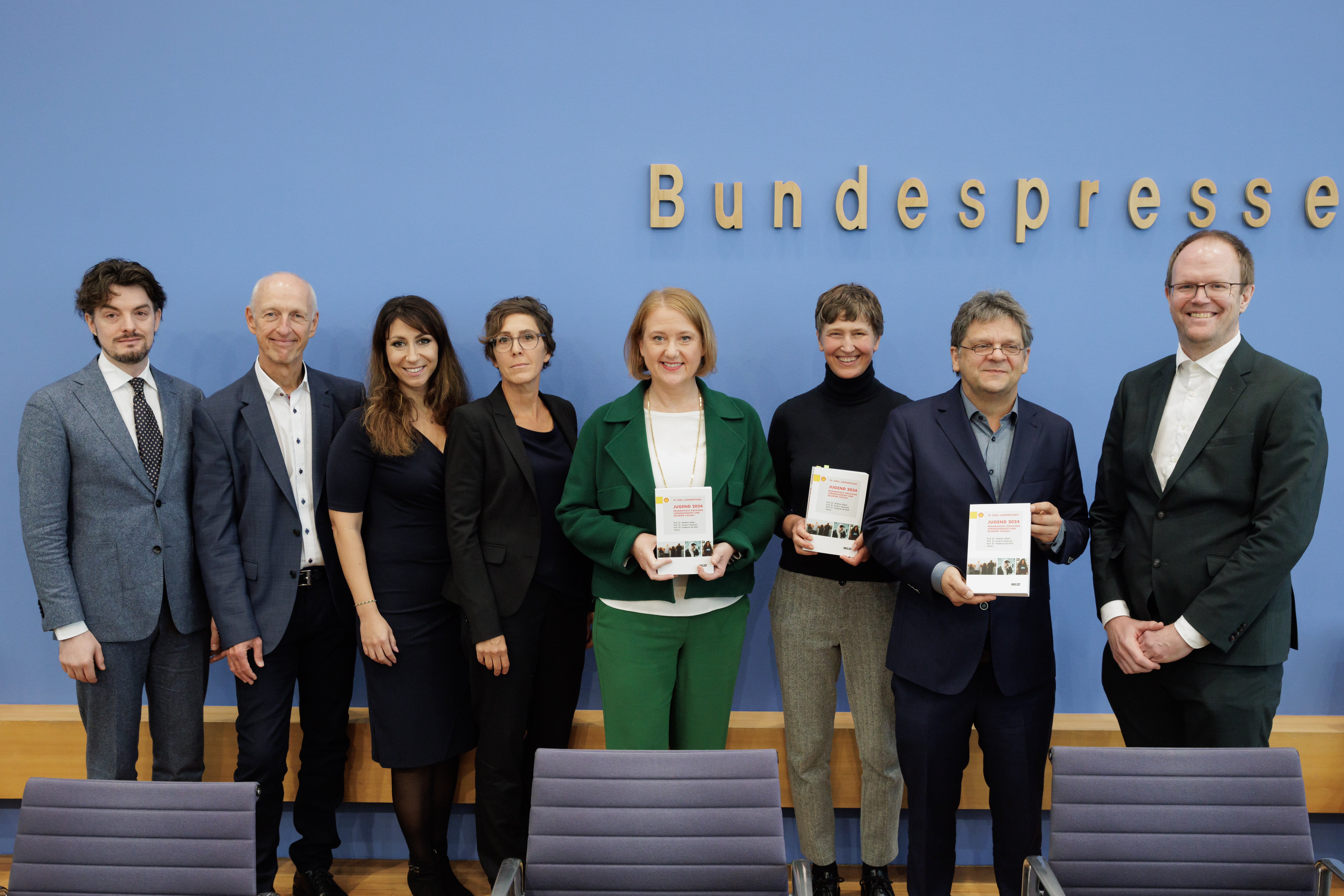
In October 2024 , the 19th Shell Youth Study was published. Since 1953, this study has examined the lives of young people in Germany and shed light on their attitudes, values, and behaviors. The study has since established itself as an integral part of comprehensive social reporting and is regarded as a reference work among experts. It is published by Shell Deutschland.
The study is published every four to five years. Since 2002, it has been conducted byaresearch team from the Institute for Youth Research ( ) at the University of Bielefeld in collaboration with Verian (formerly TNS Infratest Sozialforschung and Kantar Public). It consists of a representative survey of the 12- to 25-year-old population in Germany, conducted in person, and is supplemented by 20 qualitative interviews with young people in the same age group. The current 19th Shell Youth Study 2024 is led by Prof. Mathias Albert and Prof. Gudrun Quenzel.
The 19th Shell Youth Study builds on the trends identified in previous editions and analyzes how societal trends and the current crisis-driven changes are reflected in young people’s lives: How is the generation of 12- to 25-year-olds growing up in Germany today? What role do family , friendships, school and work, digitalization, and leisure time play? What are young people’s views on politics, society, and religion?
Some key findings from the 19th Shell Youth Study 2024
- The current wars and global political tensions have left a clear mark on young people: Fear of a war in Europe (81%) and concern about the economic situation and rising poverty (67%) are what frighten young people the most . At the same time, fewer and fewer young people are afraid of unemployment or of not finding an apprenticeship (35%).
- Young people’s interest in politics has risen steadily over the past 20-plus years. Fifty percent of 12- to 25-year-olds describe themselves as politically interested (compared to 30% in 2002), and 51% actively seek out information about politics. At the same time , the willingness to get involved in politics rose from 22% in 2002 to 37% in 2024.
- Young people’s political self-identification has remained stable overall compared to the last study in 2019; on average, they identify as slightly left-leaning. Compared to 2019, however, the proportion of young men who describe themselves as leaning to the right has increased. This is not the case among young women; among them, conversely, the proportion of those who identify as leaning to the left has increased.
- A portion of young people (12%) can be described as politically disillusioned ; these young people are susceptible to populism and express criticism of the state and society. They see themselves as disadvantaged and as those left behind by modernization and take a stance contrary to everything that corresponds to pluralistic lifestyles.
- The majority of young people have a positive view of the state and society and see great opportunities for the future. In their view, the promises of social benefits and justice—which are central to the German welfare state—as well as trust in progress remain largely intact. 76% believe that Germany offers them every opportunity to achieve their life goals.
- Climate protection remains a key issue for young people. 57% believe that everyone should reduce their standard of living for the sake of the climate and the environment.
- Young people strive for security and a high income. A secure job is important to 91%, and 83% want a high income.
- Young people continue to make diverse use of digital opportunities. The use of digital channels to obtain political information has also increased significantly.
- Good friendships and stable relationships are of the utmost importance to young people. 71% of young people would like to have children later in life. Attitudes toward the division of paid work within partnerships have shifted slightly toward a more egalitarian distribution.
Lisa Paus: “To develop effective policies for children and youth, it is important to understand the perspectives and needs of young people. The 19th Shell Youth Study shows us that although young people are currently growing up in times of crisis and conflict, the majority remain optimistic. Young people are interested in politics and want to get involved. This is where we’re focusing our efforts, for example, with the Alliance for the Young Generation that I initiated—by taking young people seriously, listening to them, and empowering them. In this way, we also ensure that we don’t lose sight of the children and young people who are less optimistic about the future. Our goal is to reliably align political action with the interests of future generations—so that children and young people do not grow weary of getting involved in our society."
Publications/Press Releases
- Federal Press Conference
- Summary of Findings
- Mathias Albert, Gudrun Quenzel, Frederick de Moll, Ingo Leven, Sophia McDonnell, Anna Rysina, Ulrich Schneekloth, Sabine Wolfert (2024): 19th Shell Youth Study 2024. Pragmatic Between Apathy and Lived Diversity – Youth 2024. Weinheim and Basel: Beltz Verlag


 Back