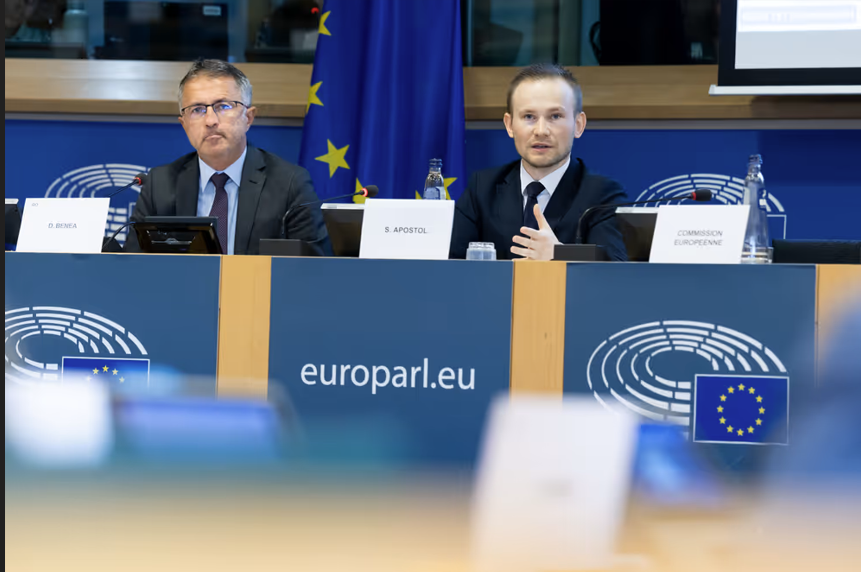
Brussels, 1 October 2026 – Verian has completed a study on how EU Cohesion Policy supports small and medium-sized enterprises (SMEs) working in critical technologies and presented its findings to Members of the European Parliament's Committee on Regional Development (REGI). The study, SMEs in critical technologies: enhancing competitiveness through Cohesion Policy funds, was requested by the REGI Committee and delivered by Verian. Stefan Apostol, Senior Researcher at Verian, presented the results and the study's recommendations for the 2028–2034 Cohesion Policy framework.
About the study
Critical technologies are now central to EU competitiveness and economic security. SMEs are key innovators in these fields, yet they struggle to scale and commercialise, particularly in capital-intensive and highly regulated sectors. Cohesion Policy is one of the EU's largest investment instruments, but its role in supporting SMEs in critical technologies had not previously been systematically assessed.
The study examines how Cohesion Policy contributed to the competitiveness of SMEs in critical technologies over the 2014–2020 and 2021–2027 programming periods, and how it interacts with the Strategic Technologies for Europe Platform (STEP). Following the European Commission's 2023 Recommendation on Critical Technology Areas, the empirical analysis focuses on four domains: artificial intelligence, biotechnology, advanced connectivity and digital technologies, and energy technologies.
Findings and recommendations
Cohesion Policy works best as an enabler. Its funding lets SMEs start or continue high-risk innovation that the market would not finance alone, and it strengthens regional innovation ecosystems. But support is concentrated in digital technologies and in early-stage R&D, firm-level effects are modest in the short term, and financing gaps persist at the demonstration and scale-up stages. Coordination with centrally managed EU programmes is not systematic, although STEP offers a workable blueprint. For the 2028–2034 MFF, the study proposes five priorities: concentrate support on fewer, larger and more mature projects in capital-intensive technologies; design programmes in a more sector-sensitive way, especially for energy; strengthen sequencing with Horizon Europe, the Innovation Fund and STEP; reduce financing and administrative barriers for high-risk SMEs; and use the European Social Fund+ to address critical-technology skills shortages.
Presenting to the REGI Committee
In his presentation, Stefan Apostol explained how the EU's approach to critical technologies developed from the 2021 strategic dependencies mapping to the 2023 Recommendation on ten critical technology areas and the launch of STEP and set out what this means for Cohesion Policy after 2027. He concluded that Cohesion Policy remains central to EU competitiveness and territorial inclusion, but it needs a stronger scale-up logic in the next programming period, and STEP shows how that alignment can work in practice.
Verian regularly carries out studies on EU innovation, competitiveness and industrial policy for the European Parliament and the European Commission.
The full study and the at-a-glance summary are available on the European Parliament's Think Tank website HERE.


 Back
Back